
What's Actually Under the Hood at Senpi
When you use Senpi, you see a chat box. Here is what is underneath it - our own model, a proprietary data layer, a runtime, and a library of strategy templates that have traded real money in public.
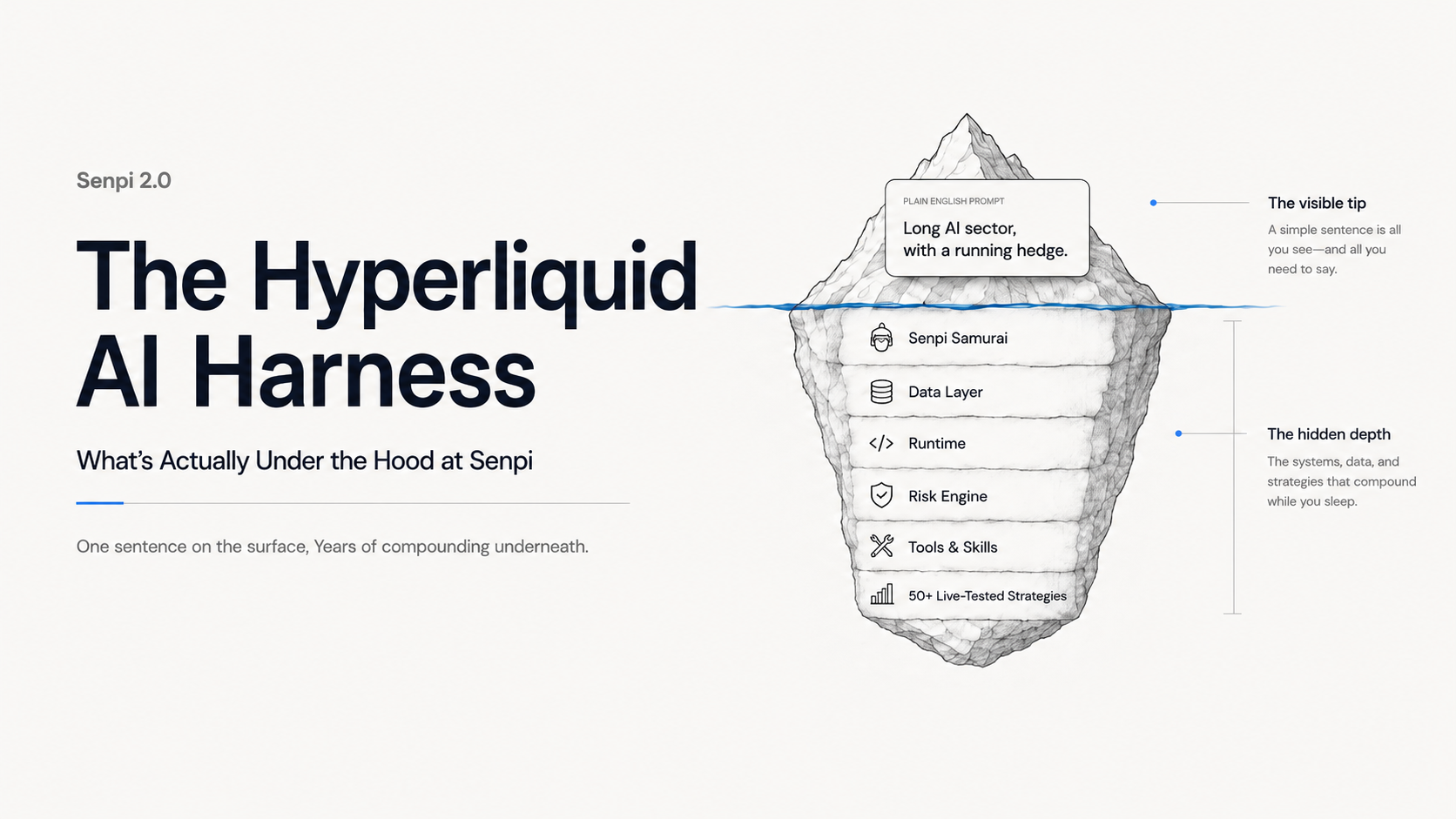
When you use Senpi, you describe what you want - "bet on the AI sector with a running hedge", "follow where smart money is moving", or "build me a fund that fades the crowd" - and seconds later it is live, trading, managing itself. It feels like one clean motion.
That simplicity is the hardest thing we have ever built.
Underneath it is a stack most people will never see: our own model, a proprietary data layer, a runtime, a risk engine, a fabric of tools and skills, and a library of strategy templates that have traded real money in public for months. Most people using Senpi will never think about any of it. But if you want to understand what you are actually working with, this is the tour.
What a harness is
In AI, a harness is everything that wraps a raw model and turns it into something that can actually do the job - the tools it can call, the data it can see, the loop that lets it act, check its work, and act again, the guardrails that keep it from hurting you. The model is the engine. The harness is the car built around it. A model with no harness is a clever conversationalist. A model inside a deep one is an agent you can hand a goal and trust to pursue it.
Most AI products in crypto run on a handful of frontier models inside the thinnest possible harness - a prompt and a chat window. Swap the logo and they are indistinguishable underneath: a general model doing the thinking, a nice interface painted on top, the word "proprietary" in the marketing.

We know, because the first generation of Senpi agents were partly that. They were genuinely good. People traded real size with them. But the intelligence making the calls was a generalist that had read most of the internet and almost nothing about what happens when a funding rate flips against you at 3am on a thin alt. It was a gifted amateur doing a job that only rewards obsession.
The difference between Senpi and a wrapper is not a better prompt - it is the depth of the harness. We built four things a thin wrapper cannot replicate: our own model, a proprietary data layer, a purpose-built runtime, and a library of proven strategies. Each took years. Each compounds on the others.
The model: Senpi Samurai 1.2

Senpi 2.0 runs on Senpi Samurai, our own model - not a general model wearing a trading costume.
It was trained on millions of real trades and real decisions made on Hyperliquid, the kind of data that does not exist on the open web because it only exists where real money is being put to work. A model raised on actual trading does not reason its way up from first principles every time it sees a setup. It recognizes the shape of things - the setups that tend to work, the ones that tend to be traps, what disciplined behavior looks like when a position is bleeding and every human instinct says to hold. It thinks in the native grammar of Hyperliquid instead of translating from generic text and hoping the translation holds.
Senpi Samurai runs in two weights. Light is the fast, always-on default - the model your agent runs on around the clock. Heavy is for the deep jobs: multi-leg strategies, wide-market analysis, reads that need to hold the whole board in view at once. You do not choose the machinery. The agent reaches for the right weight for the task.
We do not backtest. Every template and building block is forward-tested live, with real capital, in real market conditions. We have put more than $85,000 to work this way. Only what holds up makes it into your toolkit, and every one of those trades teaches the model something a backtest never could.
Because we own the model and run it on our own infrastructure, it keeps learning. Every decision the fleet makes feeds back into the next version. The agent you run next month is sharper than the one you run today, and you do not lift a finger to get it.
The data layer: what you cannot scrape
A model is only as good as what it can see.

The second layer of the harness is a proprietary, real-time data layer that turns Hyperliquid from a price feed into a map of who is winning and what they are doing. We track smart-money positioning continuously - segmenting active wallets by lifetime realized PnL, the only honest measure of who is actually good, and aggregating each cohort's net positioning per asset into a single conviction signal. This is how Senpi can tell you, in one sentence, that the most profitable wallets on the platform are heavily short a coin while the crowd piles long - a read no human could assemble manually, because by the time you have checked three wallets the picture is already stale.
On top of that structural read sits a near-term momentum layer - a rolling window tracking who is performing right now, where gains are concentrating, and whether live flow is building or fading. The signal lives in the seam between the two: when all-time proven money and near-term momentum agree, that is conviction; when they conflict, someone is early or the crowd is chasing.
Hyperliquid is not just crypto anymore. Senpi reads stocks, semiconductors, indices, commodities, and FX on the same tape as BTC and HYPE - every hour, including weekends. That is how an agent builds a genuine cross-asset thesis instead of just reacting to price.
None of this lives on the open web. It is generated, in public, by real capital trading in real time - and it feeds straight back into the model.
The runtime: turning a decision into a disciplined trade
A great read is worthless if the execution is sloppy.
The runtime is the layer that takes a model's decision and turns it into a position that is actually managed. Every Senpi strategy runs as an autonomous loop: a producer scores the universe on the signal the strategy cares about, and the runtime handles entries, sizing, and - most importantly - exits. Exits are where humans lose, so we took them out of human hands. Positions are protected by dynamic trailing stops that ratchet up as a trade works and cut fast when it does not. Conviction-based sizing. Risk gates that throttle turnover, because fees are the quiet killer of every overtrading bot.
This is the unglamorous engineering that separates a real trading agent from a chatbot that suggests trades. It runs 24/7, onchain - your agent, your wallet, your strategy, fully yours - and it brings the one thing humans cannot sustain: discipline that does not get tired, scared, or greedy at the wrong moment.
The tools and skills: connective tissue
Underneath the conversation is a fabric of tools and skills that lets an agent actually do things instead of just describe them.
On the data side, every agent has typed, real-time access to the whole platform: market data across every asset class, the smart-money engine, the momentum layer, funding regimes, cross-asset flow detection, position and account state. On the capability side, a library of skills turns common intent into reliable, repeatable behavior - discovering a strategy that fits you, authoring a custom one from a plain-English brief, deploying and managing it, reading the whole market top-down on demand. Each skill is a hardened workflow, not a one-off prompt. It knows which tools to call, in what order, and how to come back with something genuinely useful when a data source hiccups.
An agent with one tool is a toy. An agent with a coherent, battle-tested fabric of dozens of tools and skills - each one wired into the others - is something that can be handed an open-ended goal and trusted to pursue it.
The library: strategy templates that have already traded real money
Most AI trading products hand you a blank box and wish you luck. Senpi hands you a library.
We have built and battle-tested a full range of strategy templates - trend-followers and contrarians, single-asset specialists and universe scanners, smart-money copytraders, funding-rate harvesters, event traders that ride new listings, cross-asset hedges, long/short books that bet on dispersion instead of direction. These are not whitepapers. They are live agents that have traded real capital, in public, for months.
They have a public proving ground: the Hyperliquid Agents Arena, where Senpi strategies compete head-to-head with real money on the line every week. We have paid out more than $75,000 across eleven weeks of competition. Every template in your library has had to survive that - which is why starting from a proven template is a real option, not a marketing line.
A hedge fund in one sentence

The purpose of all that machinery is to make it disappear.
You should not have to think about models, runtimes, or data layers - any more than you think about combustion when you press the accelerator. The entire harness exists so that the surface can be a single sentence.
"Long the AI sector and HYPE, hedge with broad equities and weak alts."
"Follow the smartest wallets on the platform and fade the crowd."
"Bet that oil spikes if the conflict drags on, with a stop."
Each of those used to require an engineer, a quant, a risk manager, and a weekend. On Senpi it takes a sentence and a few seconds - because the model understands the intent, the data layer finds the setup, the runtime manages the risk, and the template library gives it a proven shape to start from.
Why it compounds
The easy way to build an AI product is to rent a frontier model, wrap it, and ship. It gets you to market fast, and for a while it looks like a moat. It is not. The moment your edge is a model you rent by the token, your competitor has the same edge. You own the packaging; the intelligence is a commodity anyone with a credit card can access.

The four layers of the harness do not just add - they multiply. The model is trained on data the data layer generates. The data layer gets richer from every trade the runtime executes. The runtime is proven by the strategy library. The strategy library trains the model. Each turn of that loop makes the next turn better, and none of it can be reconstructed by an outsider - it is not a file you can copy, it is years of real trades captured by infrastructure built for exactly this.
The short of it
Senpi is not an LLM with a trading skin. It is a model trained on millions of real Hyperliquid trades, a proprietary data layer that reads the whole market and the smart money inside it, a runtime that executes and protects positions with a discipline humans cannot sustain, a fabric of tools and skills, and a library of strategy templates that have already traded real money in public. Years of work, compounding.
All so that you can describe what you want in a sentence - and go to sleep.
Try it on senpi.ai
Trading involves risk. Past performance does not guarantee future results. Only trade with capital you can afford to lose.