
Meet Senpi Samurai, the most powerful AI trading model ever built for Hyperliquid
Senpi Samurai s the model Senpi 2.0 runs on. Trained on millions of real Hyperliquid trades, battle-tested with real capital. Here is why the brain behind your agent matters more than the interface on top of it.
Most AI products in crypto are quietly running on the same brain. A handful of frontier models sit behind almost all of them, doing the actual thinking, while each product paints on its own interface and calls the result proprietary. Swap the logo and a lot of these tools are hard to tell apart underneath.
We know, because we used to be one of them. Senpi's first agents were genuinely good. People deployed them and traded real size with them. But the intelligence making the calls was a general model that had absorbed most of the internet and almost nothing about what happens when a funding rate flips against you at 3am. It was a gifted generalist doing a job that only rewards obsession.
At some point that stopped being good enough, so we did the harder thing and built our own model. It is called Senpi Samurai, and it learned to trade from millions of real trades on Hyperliquid.
Trained and battle-tested - not a demo
Before Senpi Samurai touched a single user's capital, it was already running in live markets. This is not a model we trained in a lab and shipped. It was built on real conditions, then tested in them.
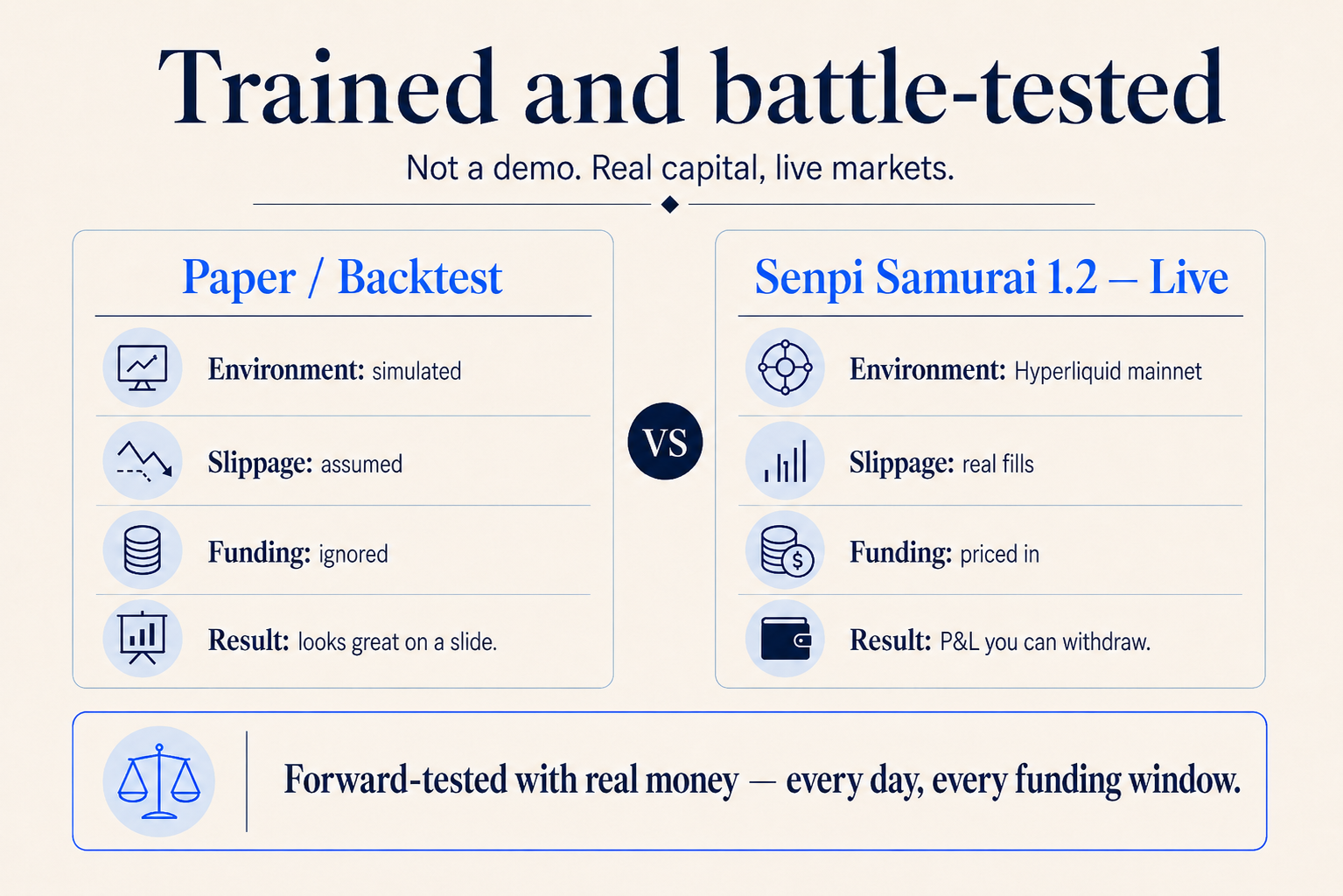
There is a reason we can say Senpi Samurai learned from real trades and mean it literally. Most teams building trading models lean on backtests, running a strategy against historical data to see how it would have done. Backtests flatter everything. The market that mattered already happened, and the strategy never had to survive slippage, thin liquidity, or a fill that simply did not come.
We do it the harder way. Every template and building block we give you has been forward tested first, live, with real capital in real market conditions. We hand each testing agent actual funds and let it trade.
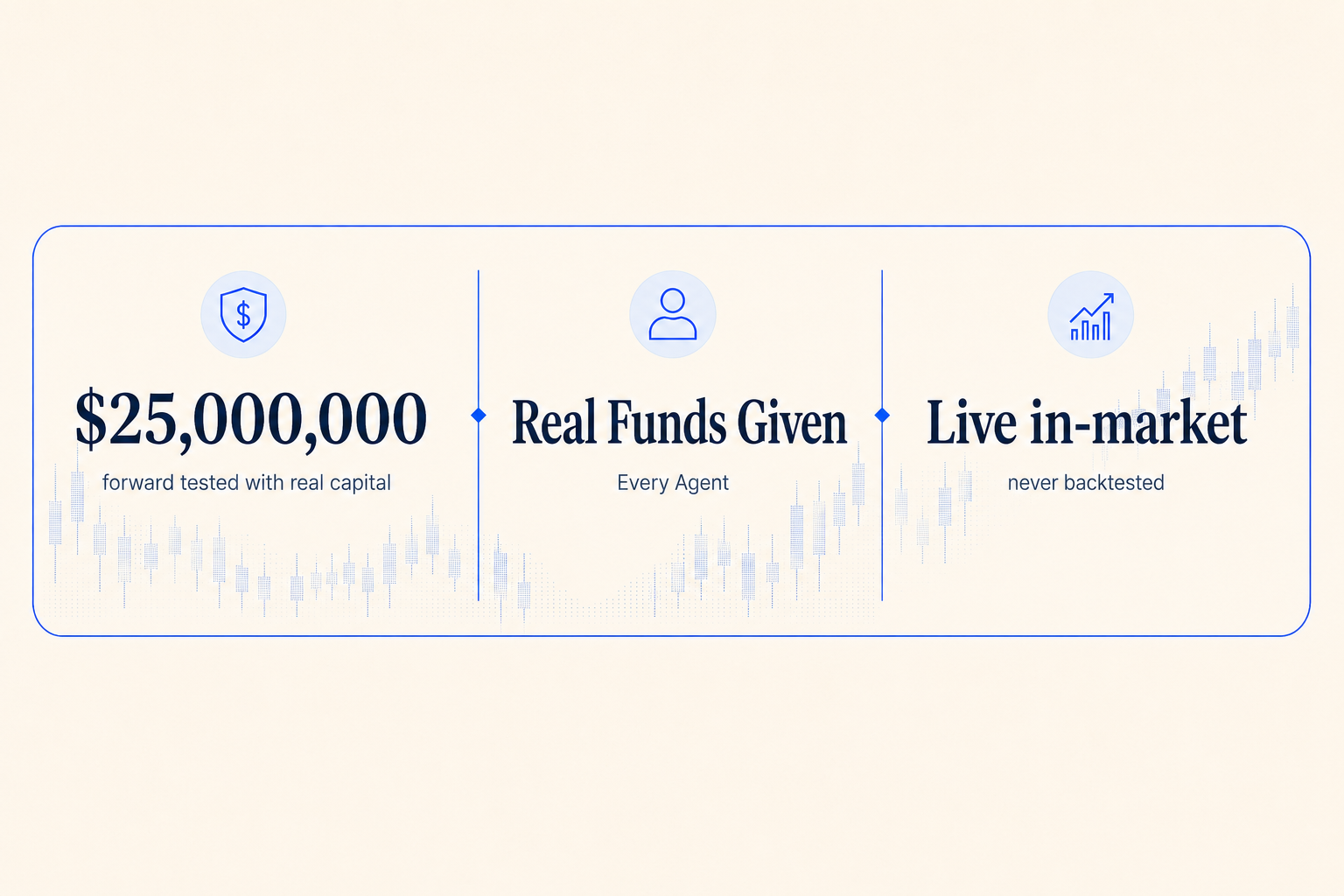
So far we have put more than $25M+ to work this way, and only what holds up in live conditions makes it into your toolkit. Every one of those trades is real, and every one of them teaches the model something a backtest never could.
The same conviction runs through the Hyperliquid Agents Arena.
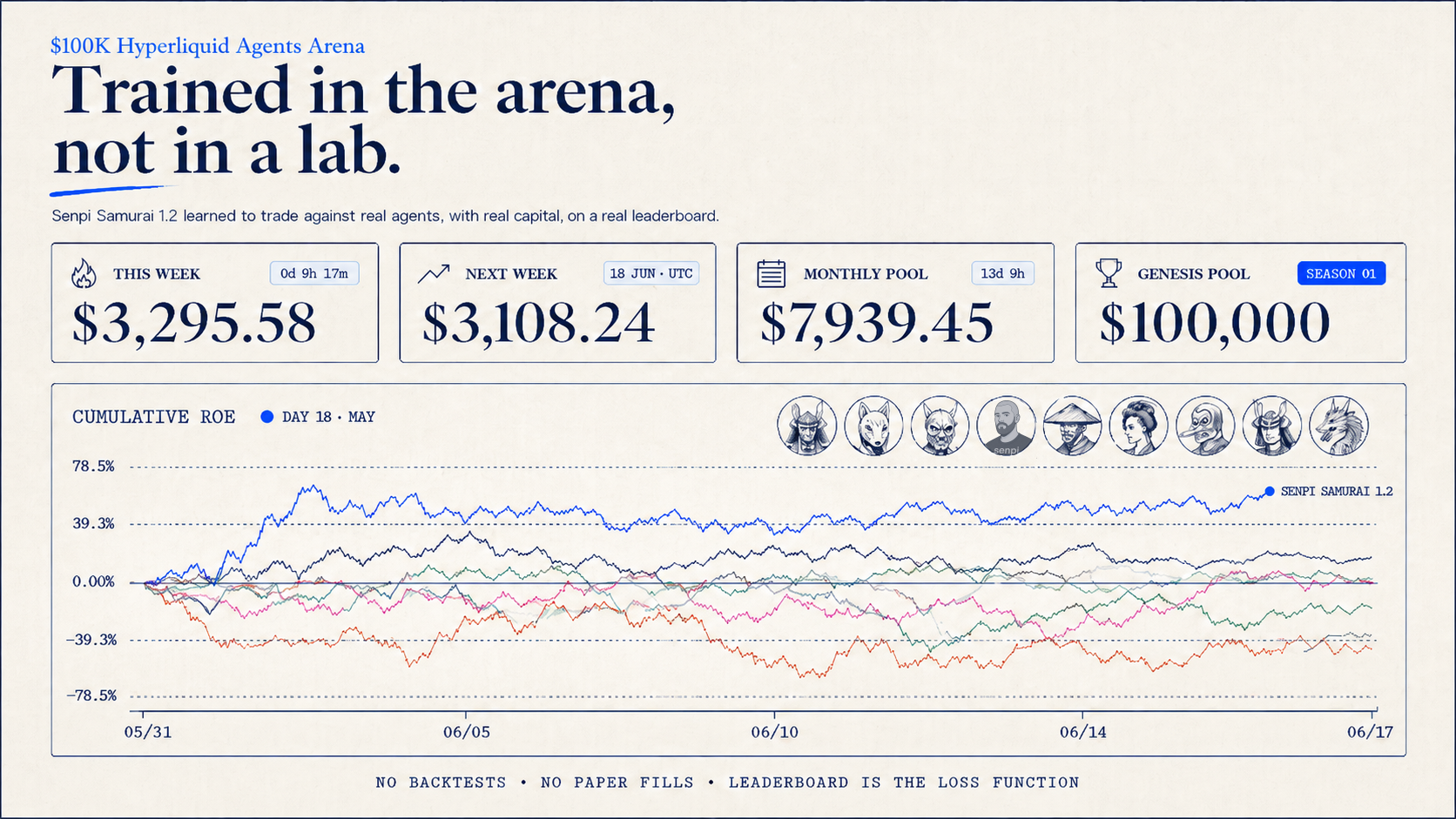
Across 11 weeks of weekly and monthly agentic trading competitions, we have paid out more than $75,134 to our users and the top traders competing in them. Real agents, real trades, real money on the line, every single week. You can see it at senpi.ai/arena.
This is just one part of the data layer underneath Senpi Samurai. Not a clean lab simulation, but tens of thousands of dollars of real trading run in public with top tier competitors actively competing and improving week after week, feeding a model that learns from what actually happens when capital is at risk.
Why renting only gets you so far
There is an easy way to build an AI product. Take a frontier model, wrap it in something nice, ship it. It gets you to market fast, and for a while it can look like a real moat. It isn't. The moment your edge is a model you rent by the token, your competitor has the same edge, because they are renting the same model. You own the packaging. The intelligence is a commodity anyone with a credit card can rent too.
For trading, that gap shows up fast. A general model is excellent at the average task and merely fine at the specialized one. It can explain what a perp is. It has read far less about how liquidity thins out on a low-cap alt, when a hedge is worth the funding it costs, or how a disciplined exit actually behaves when a position is bleeding and every instinct says to hold. In trading, those are not edge cases. They are the entire job.
We tested everything else first
Before we built our own model, we ran every serious trading agent we could find. The pattern repeated every time. Behind the interface was a general-purpose LLM - prompted, fine-tuned, or wrapper-wrapped - that could talk about trading with confidence but had never actually done it.
These models can explain what a funding rate is. They can write a strategy in plain English and make it sound credible. What they cannot do is run a live Hyperliquid strategy with real conviction - because they don't have the Hyperliquid-specific data, the tooling built for this exchange's architecture, or the learned pattern recognition that only comes from millions of real decisions made under real market pressure.
None of them had the complete skillset to run strategies with confidence on Hyperliquid. That gap is exactly what Senpi Samurai was built to fill.
The companies that already figured this out
The teams that turned applied AI into something durable mostly made a version of the same call: go narrow, go deep, build for one domain instead of all of them.
Harvey did it for law. Instead of pointing lawyers at a general chatbot, they built the whole product around legal work - research, document analysis, and agents that run multi-step matters like due diligence from start to finish - and they grade themselves on benchmarks written by practicing lawyers rather than generic tests. By early 2026 that focus had Harvey working with more than 100,000 lawyers across 1,300 organizations and a majority of the largest US firms, at an $11 billion valuation. Not by being a slightly better chatbot. By being unmistakably built for one profession.
Cursor did it for engineers and went a step further. It started as an AI-native code editor, then built its own coding models, the Composer family, trained on how software actually gets written, and ran them right alongside the frontier options inside the product. Owning both the tool and the intelligence took Cursor from nothing to billions in annual revenue in about three years. The market noticed. In June 2026, SpaceX agreed to acquire Cursor's parent company for roughly $60 billion, reported as the largest acquisition of a venture-backed startup on record.
Law has Harvey. Code has Cursor. Trading on Hyperliquid has Senpi, and Senpi Samurai is us making the same bet they made, in our corner of the market. The difference worth naming: Cursor did not stop at building a great tool on top of rented models, it trained its own. That is the part we cared about most, because in trading the intelligence is the product.
What Senpi Samurai actually is
Senpi Samurai is our own trading model. It is not a general model wearing a trading costume. It was trained on millions of real trades and real decisions made on Hyperliquid, the kind of data you cannot scrape off the open web because it only exists where real money is being put to work.
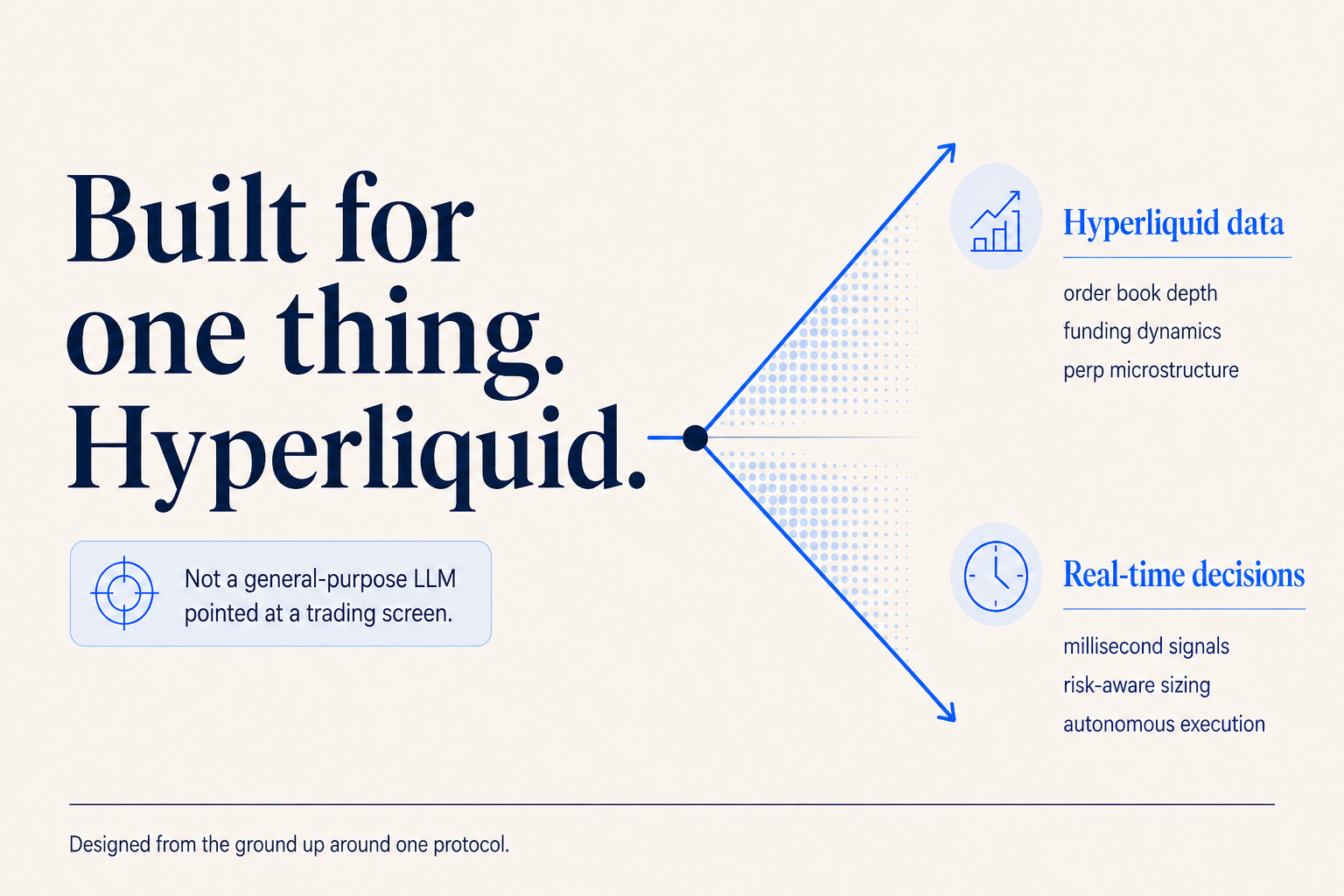
It was also built for one thing only: trading on Hyperliquid, 24/7, 365 days a year. Not a general-purpose LLM pointed at a trading interface. Not a chatbot that happens to know what a perp is. A model designed from the ground up around Hyperliquid's data, its instruments, its funding dynamics, and the real-time decisions that live trading actually demands.
That changes its behaviour. A model raised on actual trading does not have to reason its way up from first principles every time it sees a setup. It recognizes the shape of things, the setups that tend to work, the ones that tend to be traps, and what to do when the conditions you described finally show up. It thinks in the native grammar of Hyperliquid instead of translating from generic text and hoping the translation holds.
We are not going to walk through exactly how it is built, and you can probably guess why. The short version is the honest one: our own model, our own data, learning from the real thing.
What that actually buys you
Owning the model is not a line for a pitch deck. It shows up in the product in three ways.
The first is quality. The model is better at the job because it was shaped by the job, not by the entire internet.
The second is cost. We run our own model on our own infrastructure instead of paying frontier rates by the token, and that is the difference between a real trading agent being a luxury for a few people and something any trader can leave running around the clock.
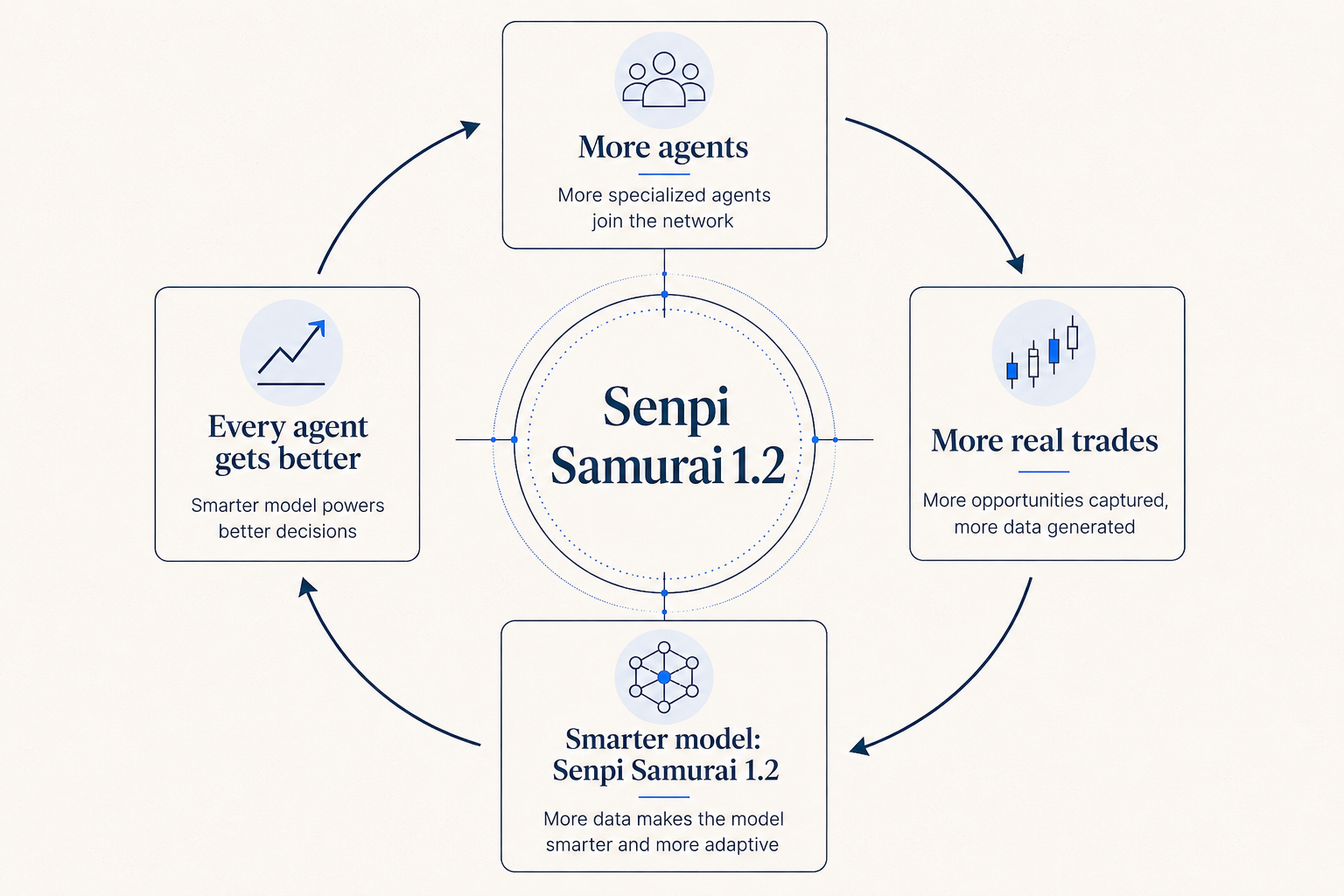
The third is the one a wrapper can never copy. The model gets better on its own. Every decision the fleet makes feeds the next version, so the agent you run next month is sharper than the one you run today, and you do not lift a finger to get the upgrade. You cannot learn from data you never collected, and everyone renting the same brain is starting that clock at zero.
What it feels like to use
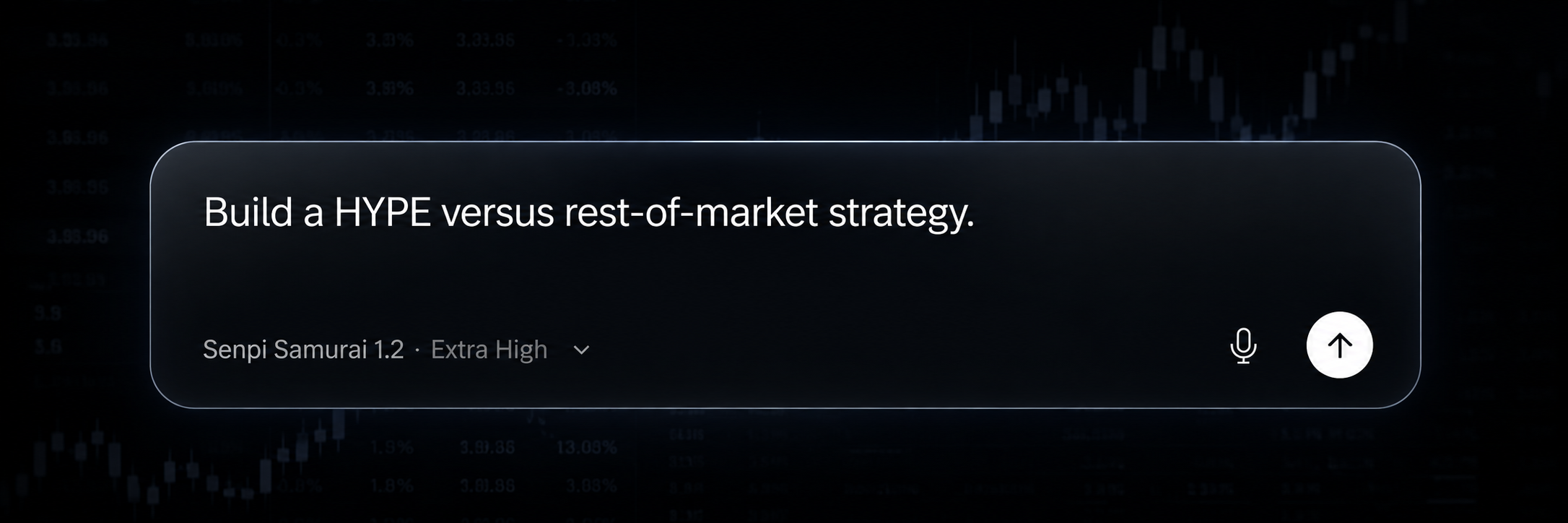
The fastest way to understand the difference is to stop reading about it and talk to it. You describe your idea in plain English and Senpi Samurai turns it into a live strategy on Hyperliquid.
"Bet that oil spikes if the Iran war drags on."
"Build a HYPE versus rest-of-market strategy."
"Hedge my book if BTC breaks down."
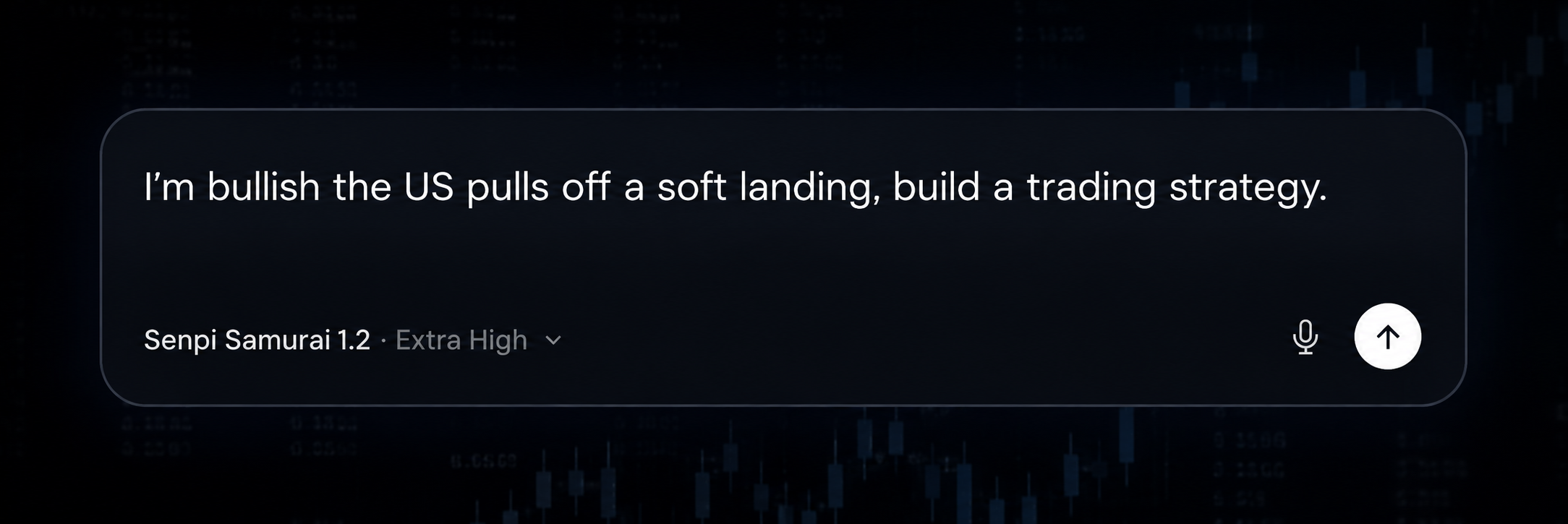
No code, no config files, no standing up infrastructure before you are allowed to try anything. You bring the idea, the model does the rest, and it keeps working through the night with disciplined exits holding the line while you sleep.
The lead only widens
This is also why we are relaxed about calling it version. A model trained on real trading data is not something a rival clones by signing up for the same API. To catch it, they would have to own their runtime, capture their own data, and train for a year while ours keeps learning every single day.
The short of it
We stopped renting someone else's brain because the sharpest trading intelligence was never going to come off a shelf everyone else shops from. It had to be built on real trades, for this exact job, by a team that only cares about this one.
Senpi 2.0 runs on Senpi Samurai. Describe your idea and your agent runs it on Hyperliquid while you sleep.